Dienstag, 15. Januar 2013

Interview mit Betreiberin von TrekNation
Freitag, 11. Januar 2013
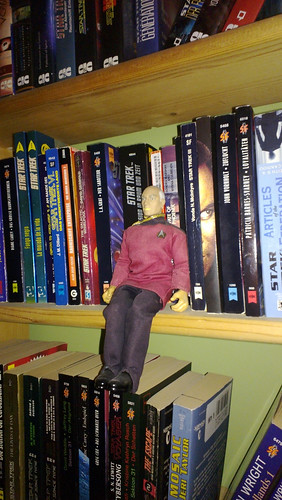
Samstag, 5. Januar 2013
Gene Roddenberry Star Trek Collection @ UCLA

Conrad Quilty-Harper: "Star Trek: The Tour Phasers on Stun!", 5. Februar 2008, Flickr, CC-BY-NC-SA
Der Star Trek Defender-Charaktertest ;-)

| Der "Star Trek Defender" Charaktertest Captain Lairis Ilana Du weißt, was du willst, stehst für deine Sache ein und die Leute halten dich für eine geborene Führungspersönlichkeit. Deine Warmherzigkeit und dein Humor sind so ansteckend, wie deine Temperamentsausbrüche abschreckend sind. Für Schwächere setzt du dich rückhaltlos ein - auch wenn das bedeutet, dass du selbst in die Schusslinie gerätst. Wenn du etwas für richtig hältst, findest du sehr unorthodoxe Wege, dich durchzusetzen - manches grenzt schon an hinterhältige oder illegale Methoden. Damit machst du dir natürlich nicht nur Freunde. Kein Wunder, dass du öfter mal sarkastisch bist.
|
 Quizzes and Personality Tests |

Mittwoch, 2. Januar 2013
Early web: 50% porn, 50% Star Trek fansites
Expressing what I thought was wrong
"I was delighted to find fanfic. It was such a wonderful way of expressing what I thought was wrong with the original TV show, and putting it right".
Das bringt es so auf den Punkt, dass ich überlege, es als Motto für meine Diplomarbeit zu verwenden...
Sonntag, 30. Dezember 2012
Ankündigung: Pictorial History of Science Fiction Fanzines
 | Für Juli 2013 ist das Buch "The Interpretation of Zines: A Pictorial History of Science Fiction Fanzines" von Luis Ortiz bei Nonstop Press angekündigt. |
Verlagstext: "A remarkable journey through the development of a popular subculture, from its earliest fans in the 1930s who used primitive desktop-printing technology to create amateur zines mimicking newsstand magazines to more recent zines dedicated to media science fiction, this chronicle of sci-fi fandom is a unique, eccentric, and richly entertaining look at the genre. This visual compendium showcases the best, most interesting, and strangest fanzines ever produced and provides the historical background of their development and detailed information on the writers and artists involved in their creation. From Ray Bradbury and Gene Simmons to Stephen King and Roger Ebert, the work of famous sci-fi zinesters is explored as well as all the marginal ephemera from a once isolated little genre that has now gained worldwide recognition and acceptance".
Whatcha mean, what's a zine?
 | In der bibliothekarischen Comicreihe "Unshelved" von Gene Ambaum und Bill Barnes widmet sich eine Ausgabe dem Buch "Whatcha Mean, What's a Zine? The Art of Making Zines and Mini Comics" von Esther Pearl Watson und Mark Todd, erschienen 2006 bei Graphia Books [follow the link]. |
Dienstag, 23. Oktober 2012
Marvel and Wonder in Literature and Literary Theory
Our panel seeks to explore the concept of wonder and how it functions in literature, both as an emotional response to the foreign and as a stimulus for contemplation and critical reflection. It is through this very emotion, one could argue, that we position ourselves in the world and separate the Self from the Other. Yet, this experience is also what prompts our curiosity for discovery and provokes our search for explanations.
Genres such as travel literature seek to capture these moments of encounter with the foreign in terms of 'content'. Wonder, however, is also an effect that can be sought in the literary 'form' as well and has been a topic of theoretical discussion throughout the ages: from Aristotle (to thaumaston), the medieval Arab world (ta'ajjub), medieval Europe (meraviglia/admiration), the Enlightenment (sublime), to Russian Formalism (defamiliarization/Verfremdung).
We aim at discussing questions such as:
The seminar welcomes papers looking at any of these aspects of wonder, in any period and region, either as it is treated theoretically or as an analysis of a literary text. Please submit a 250-words abstract by November 15, 2012 through the following link: http://acla.org/submit/index.php.
Seminar organizers: Lara Harb (New York University): lara.harb@gmail.com; Reinhard Möller (Justus Liebig Universität Giessen/Cornell University): Reinhard.M.Moeller@gcsc.uni-giessen.de. For any questions, please feel free to contact the seminar organizers directly by e-mail.<zitatende>
Donnerstag, 20. September 2012
Bibel als Fan Fiction?
Montag, 16. Juli 2012
Harriet Potter
Star Trek bei "Planet Wissen"
Donnerstag, 17. Mai 2012
Das bloße Öffnen der Konvolute
"Je größer die Mühe, die ich über Monate hinweg an dieses Vorhaben wandte, desto kläglicher dünkten mich die Ergebnisse und desto mehr ergriff mich, schon beim bloßen Öffnen der Konvolute und Umwenden der im Lauf der Zeit von mir beschriebenen ungezählten Blätter, ein Gefühl des Widerwillens und des Ekels, sagte Austerlitz. Und doch sei das Lesen und Schreiben immer seine liebste Beschäftigung gewesen. (...) Jetzt aber war mir das Schreiben so schwer geworden, daß ich oft einen ganzen Tag brauchte für einen einzigen Satz, und kaum daß ich einen solchen mit äußerster Anstrengung ausgesonnenen Satz niedergeschrieben hatte, zeigte sich die peinliche Unwahrheit meiner Konstruktionen und die Unangemessenheit sämtlicher von mir verwendeter Wörter. Wenn es mir dennoch durch eine Art Selbsttäuschung bisweilen gelang, mein Tagespensum als erfüllt anzusehen, dann starrten mir jeweils am nächsten Morgen, sowie ich den ersten Blick auf das Blatt warf, die schlimmsten Fehler, Ungereimtheiten und Entgleisungen entgegen" (W.G. Sebald: Austerlitz. München: Hanser 2001, S. 175 - 176).
Freitag, 6. April 2012
Character formation in fan fiction
Montag, 26. März 2012
Archives and fannish history
Zitat aus: Versaphile: "Silence in the library: Archives and the preservation of fannish history". In: Transformative Works & Cultures 6 (2011), S. 2
Freitag, 23. März 2012
Zines in Bibliotheken - warum?
"Zines are the purest form of counterculture expression that exists in printed form, and insightful indicators of current times. They represent the under-represented and give voice to marginalized members of society. Zines are interesting and cheap, and as a public library, it is our job to provide access to all types of information".
Freitag, 14. Oktober 2011
Dissertation über SF-Fankultur
Aus dem Abstract: "This study reveals science fiction fan culture as it was observed during a science fiction convention in southern California in 2009. Conventions, although social gatherings, are also places where learning takes place, and the culture is shared. The researcher, a fan herself, collected demographic data through an anonymous survey, then interviewed several fans to develop information about their educational history, cultural attitudes, and interactions with text. The evidence presented shows this group identifies itself as a subculture with its own language, arts, values, and traditions. Fandom also exhibits many characteristics of an affinity group as described by Gee (2003), in that its members are united by a common cause, and hold similar attitudes toward knowledge acquisition and information sharing".
Dienstag, 20. September 2011
Zine Fest mit Bibliotheksbeteiligung
Organisatorin Lacey Prpic Hedtke in einem Interview mit Loren Green über das "Twin Cities Zinefest" in Minneapolis für das Blog dressingroom.