Posts mit dem Label fanstudies werden angezeigt. Alle Posts anzeigen

Dienstag, 14. Juli 2026

Live long and prosper! Streifzüge durch Fanfiction Studies

In der Zeitschrift "UR: Das Journal. Studentische Forschung an der Universität Wien" ist im September 2025 ein Band zum Thema "Live long and prosper! - Streifzüge durch Fanfiction Studies" erschienen.

-- Fanfiction und Fandom sind eigentlich moderne Phänomene – der Begriff "Fanfiction“ stammt aus den Sechzigerjahren –, zugleich ist die Weltliteratur geprägt vom literarischen Transfer von Figuren, Themen, Topoi. Dieser Transfer beschränkt sich nicht nur auf Weltliteratur. Ganz im Gegenteil ist auch die Popkultur ein Schauplatz von Transfers. Fans verarbeiten in verschiedenen Medien Gedanken, Gefühle, Ideen zu ihren Lieblingsfiguren, bauen Welten, verhandeln Geschehnisse im „real life“. Daraus entstehen Fanart, Fanfiction, Cosplays, Musikvideos und viele andere Kreationen. Diese Kreationen haben wir – 32 Studierende und ich als ihre Lehrende [Anm. Erika Unterpertinger] – im Proseminar "Live long and prosper: Streifzüge durch Fanfiction Studies" mit einem besonderen Fokus auf Fanfictions zum Thema gemacht. Das Ergebnis kann man hier nachlesen! --

Link: https://journals.univie.ac.at/index.php/urj/issue/view/727

Montag, 2. Juni 2025

CFP: Special issue of Popular Culture Studies Journal on Star Trek: Enterprise at 25

CFP: Special issue (or section, depending on number of submissions) of Popular Culture Studies Journal on Star Trek: Enterprise at 25 (October 2026)

Guest editrix: Dr Melissa Beattie (remote/adjunct, SNHU), tritogeneia@aol.com

In September of 2001, Enterprise (later retitled Star Trek: Enterprise) debuted on UPN in the US. Though diegetically the earliest in the Star Trek universe, as it is a prequel set in the 22nd century, this series was the last entry of the franchise to be broadcast-only, with the 2009 ‘Kelvinverse’ being on cinema screens and subsequent Trek series being available via streaming. Despite its unique position within the franchise, however, the series has been critically under-studied. Because of its neglected importance, the Popular Culture Studies Journal seeks 6-8000 words papers focusing upon Enterprise/Star Trek: Enterprise, to be published in conjunction with the twenty-fifth anniversary of the series premiere.

Topics

Topics for papers may include (but are by no means limited to) the following:
  • Production context (industrial and/or sociocultural)
  • Media representation of and in the series (identities, Othering, etc)
  • Production elements (performance, direction, writing, aesthetics, music, etc)
  • Afterlives (pop culture references, subsequent work by the regulars/recurrings, etc)
  • Paratexts and intertexts
  • Tie-ins
  • Canonicity
  • Fans and fandom
  • Fan activities (fanfic, vids, conventions, cosplay, etc)
  • Technology (representation of and/or changes in)
  • Prequels and/in telefantasy
  • Diegetic/extra-diegetic history/-ies

Proposals from graduate students and independent scholars are welcome; undergraduate proposals will be considered as well. Informal enquiries may be sent to Dr Beattie at tritogeneia@aol.com.

Please submit a 250-300 word abstract and 100 word author bio by 15 June 2025 to the above email address.

Expected timeline

  • 1 July, 2025: decisions sent out on abstracts.
  • 1 December, 2025: complete articles due for peer review.
  • 1 February, 2026: articles returned after peer review.
  • 1 May, 2026: revised articles due.
  • 1 June, 2026: any additional changes will be requested of authors.
  • 1 September, 2026: final deadline.
  • 15 October, 2026: publication of the volume.

Dienstag, 11. März 2025

Konferenz "Fanfiction im Archiv", Marbach

Fanfiction transformiert, aktualisiert aber auch. Sie macht bekannte Quellen auf neue Art lebendig, sozial und sogar interaktiv. Doch welche Rolle spielt Fanfiction im deutschsprachigen Sprachraum und welche Themen und Motive werden in der Fanfiction rezipiert und verarbeitet? Zu welchen Quellen schreiben deutschsprachige Fan-Gemeinden ihre Geschichten, was wird gelesen? Welche Autor/-innen und Geschichten des deutschsprachigen Kanons finden sich in Fanfictions wieder? Was macht diese Interaktion mit der Literatur und mit denen, die sie bearbeiten? Wo spielt Fanfiction nicht nur in der Populärkultur, sondern auch in der Wissenschaft, in Unterricht und Lehre eine Rolle? Wie wird sie beforscht? Das DLA hat im Oktober 2024 begonnen, Fanfiction zu sammeln und möchte gemeinsam mit Wissenschaftler/-innen und Expert/-innen dem Thema unter vielfältigen Gesichtspunkten nachgehen.

In diesem Kontext entstehen eine Crowdsourcing-Plattform für Praxisprojekte, ein Workshop zum Thema und ein archivarischer Zugang zum Material. Das Konzept Fanfiction wird dabei in seiner Komplexität erfasst: als soziale, kollaborative, subversive Praxis im stetigen Fluss.

Am 20. und 21. März findet die Tagung "Lest ihr noch oder schreibt ihr schon? Fanfiction im Archiv" online statt.

https://networks.h-net.org/group/announcements/20062001/konf-lest-ihr-noch-oder-schreibt-ihr-schon-fanfiction-im-archiv-20

Freitag, 20. Dezember 2019

Call for Papers: Special Issue of the Journal of Fandom Studies on Archives and Special Collections

Abstract submissions are invited for a special issue of the Journal of Fandom Studies. This issue will focus on archives and special collections relevant to scholars of fan studies. Topics addressed might include profiles of institutional collections with primers for use, research, archiving and curatorial practices performed by fans, and archival and archontic theory.

Other possible topics include:

  • Historical perspectives on collecting fan material in libraries and archives
  • Race, gender, and queerness in fan collections and in library subject indexing
  • Logistical and ethical issues of access to fan materials
  • Current research and collecting gaps in the documentary record
Contributors may also submit short profiles (500 words) of relevant institutional collections with curatorial contact information as part of a special Research Guide section of this issue.

All articles submitted should be original work and must not be under consideration by other publications.

Please send abstracts of 250 words (including a title and keywords) with biographical statements of 100 words to Cait Coker (cait@illinois.edu) and Jeremy Brett (jwbrett@library.tamu.edu) by February 28, 2020. If accepted, contributions should be no longer than 9000 words, including notes and references, with completed drafts expected in October 2020.

Freitag, 16. Juni 2017

Themenheft Queer Female Fandom erschienen

In der Zeitschrift "Transformative works and cultures" erschien gerade ein Themenheft zu Queer Female Fandom, herausgegeben von Julie Levin Russo and Eve Ng. Inhalt:
  • Editorial: Envisioning queer female fandom - Eve Ng, Julie Levin Russo
  • Between text, paratext, and context: Queerbaiting and the contemporary media landscape
    Eve Ng
  • "Yes, the Evil Queen is Latina!": Racial dynamics of online femslash fandoms - Rukmini Pande, Swati Moitra
  • Queerly imagining Super Girl in an alternate world: The fannish worlding in FSCN femslash romance - Jing (Jamie) Zhao
  • Female-centered fan fiction as homoaffection in fan communities - Ria Narai
  • Locating black queer TV: Fans, producers, and networked publics on YouTube - Faithe Day, Aymar Jean Christian
  • Constructing queer female cyberspace: The L Word fandom and Autostraddle.com - Kelsey Cameron
  • Femslash goggles: Fan vids with commentary by creators - Julie Levin Russo
  • Where the femslashers are: Media on the lesbian continuum - Mel Stanfill
  • The surface of women - Lucy Irene Baker
  • On defining yuri - Erica Friedman
  • Unseen international music idol femslash - Elaine Han Lin
  • Coming out on Grey's Anatomy: Industry scandal, constructing a lesbian story line, and fan action - Tanya D. Zuk
  • Bisexual erasure in queer sci-fi "utopias" - Victoria Serafini
  • Once Upon a Time in queer fandom - Sandra Strauch
  • By any media necessary: The new youth activism, by Henry Jenkins et al. - Allison McCracken
  • Girls' feminist blogging in a postfeminist age, by Jessalyn Keller - Alice Marwick
  • International perspectives on shojo and shojo manga, edited by Masami Toku - Nicolle Lamerichs

Mittwoch, 1. April 2015

Fanzines: Schaufenster in Jugendszenen

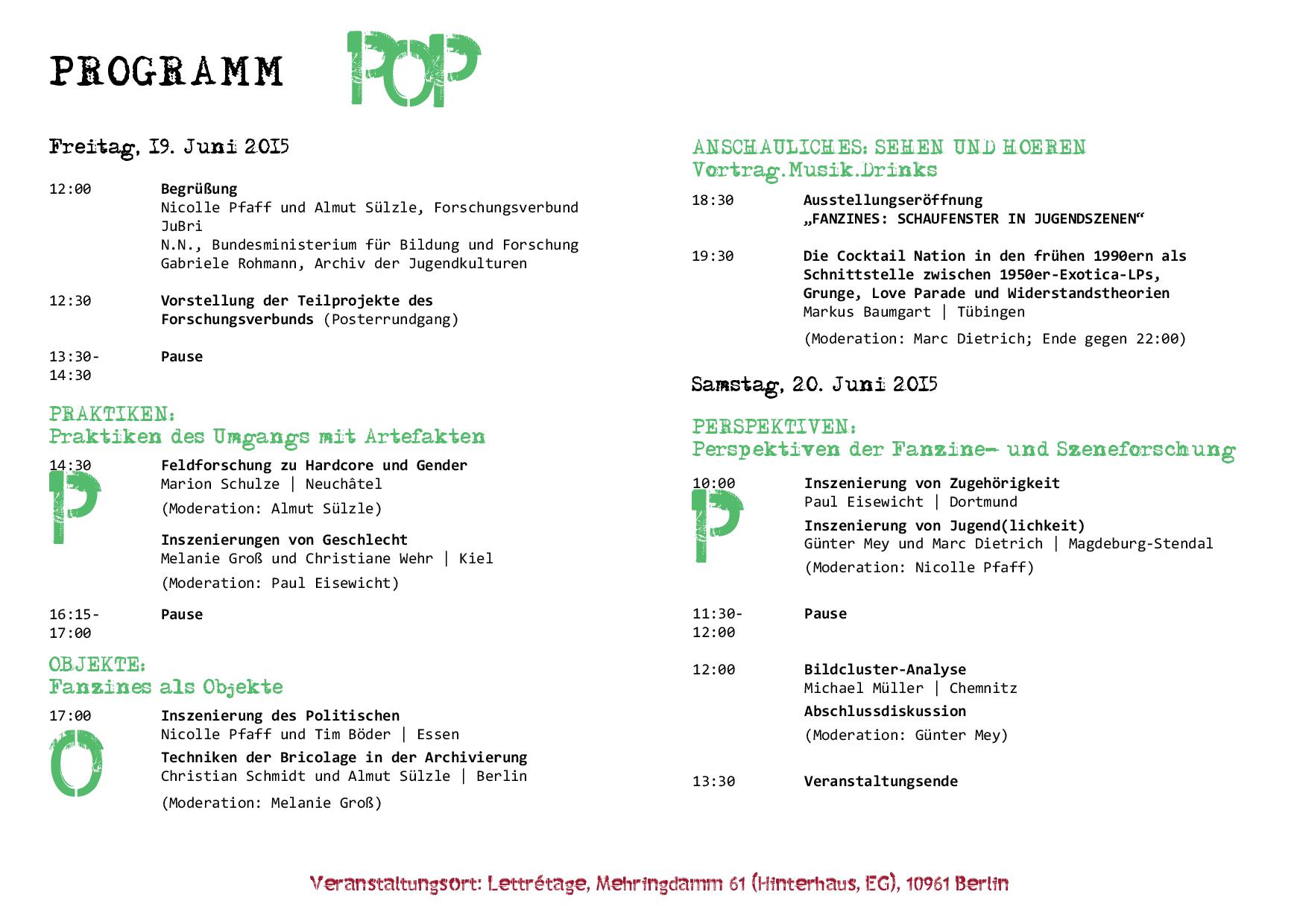
Am 19./20. Juni 2015 findet in der Lettrétage, Mehringdamm 61, 10961 Berlin, eine Tagung zum Thema "Fanzines: Schaufenster in Jugendszenen. Praktiken. Objekte. Perspektiven" statt (Programm als jpg).

Im Zentrum der Tagung stehen jugendkulturelle Wissensbestände, Wert- und Normorientierungen – kurz: Sinnkonstruktionen – wie sie sich in Artefakten aus jugendkulturellen Szenen, insbesondere in Fanzines dokumentieren. Im Rahmen von Fachvorträgen, einer Ausstellungseröffnung und einem Rahmenprogramm werden nicht nur die archivarische und wissenschaftliche Aufarbeitung des Fanzine-Bestandes des Archivs der Jugendkulturen e.V. vorgestellt, sondern auch erste Ergebnisse aus den Teilprojekten des vom Bundesministerium für Bildung und Forschung unterstützten Forschungsverbunds "Techniken jugendlicher Bricolage – Interdisziplinäre Perspektiven auf jugendkulturelle Praktiken des Umgangs mit alltagskulturellen Objekten"(JuBri) präsentiert.

Am Beispiel der Hardcore-Szene werden in einer ersten Session Praktiken des Umgangs mit Artefakten rekonstruiert – vor allem im Hinblick auf Inszenierungen von Geschlecht. In der zweiten Session geht es um Fanzines als Objekte. Im Vergleich zu anderen Printmedien wird nach Inszenierungen des Politischen und nach Herausforderungen der Fanzine-Archivierung gefragt. Schließlich entwickelt eine dritte Session Perspektiven der Fanzine- und Szeneforschung. Dabei geht es um Analysen zur Inszenierung von Zugehörigkeit und Jugendlichkeit sowie um Zugänge zu digitalen Formaten der (jugendkulturellen) Kommunikation und Präsentation. Im Rahmen der Tagung wird die Ausstellung "Fanzines: Schaufenster in Jugendszenen" gezeigt. Anschließend können die Teilnehmenden Plattencoveranalysen mit Musik und Cocktails von DJ Markus Baumgart genießen.

Anmeldung bis zum 13. Juni unter jubri@jugendkulturen.de. Der Veranstaltungsbeitrag beträgt 25 Euro. An der Ausstellungseröffnung und dem anschließenden Abendvortrag am Freitag, 19. Juni (Beginn: 18:30 Uhr) kann auch ohne Anmeldung kostenlos teilgenommen werden.

Dienstag, 23. Juli 2013

CFP: Imagining Science Fiction Dangerously

Source: Mail sent by Sean Redmond to the Fan Studies list.

The power of science fiction lies in its dangers. Science fiction imagines other worlds that can challenge, unsettle, and disturb the known world. It turns on dangerous ideas, affective ruptures, political critique, and unfamiliar textures. It has the power to threaten the established order of things and open gaps in the way we conceptualise the contemporary world. But are we losing sight of the dangers of science fiction as we try to come to understand it? Istvan Csicsery-Ronay warned "there is a danger in making Science Fiction into an academic specialty. [...] I'm somewhat suspicious of treating Science Fiction as if it were a circumscribed subject with a canon and set of reading protocols" (interview with Rain Taxi, 2009).

This special issue aims to address questions of:

* How can science fiction continue to be imagined dangerously in all its forms – from literature to film to gaming to art – in the face of it becoming a "discipline"?

* How does science fiction recover its danger, away from the neo-liberal safety of commercialisation and criticism that renders it as a digestible genre?

* How can academia approach science fiction in a way that both contributes to, and avoids eroding, the power and danger of science fiction?

* How can the tropes of science fiction be challenged to imagine new intersections of science and fiction?

* What do advances in science and technology mean for the dangerous dimension of science fiction?

* How is science fiction used dangerously; for example in military planning or by environmentalists imagining dangerous futures?

* How can the spaces and the textures of science fiction continue to be imagined as dangerous?

* How do practices of reading contribute to science fiction becoming "safe" (in other words, are we missing the point?), and how can practices of reading make sci-fi dangerous again?

* Where is science fiction the most unsettling, confronting, and urgent?

We invite contributions that address any of these questions from the disciplines of literature, film, gaming, art, and science and technology, and any other field with an investment in the possibilities of imagining science fiction dangerously.

The issue will be edited by the Emerging Research Group in Science Fiction at Deakin University, Australia (lead by Associate Professor Sean Redmond, Associate Professor Leon Marvell, Dr Elizabeth Braithwaite, Dr Chris Moore, and Trent Griffiths, postdoctoral student), aiming for publication in late 2014.

We welcome abstracts for of 300-350 words, along with a short biography, emailed to sean.redmond@deakin.edu.au or leon.marvell@deakin.edu.au by Friday September 20th 2013. General enquiries about the special issue or the research group are also welcome.
Notification of acceptance of articles will be by Friday October 18th 2013. Completed articles should be original work which has neither been simultaneously submitted for publication elsewhere nor published previously, and will be due in April 2014.

Dienstag, 23. April 2013

CfP: Journal of Cult Media

Hinweis aus der Fanstudies-Mailingliste:

<snip>The Journal of Cult Media has relaunched and is currently accepting submissions for issue six. Intensities is an online journal first launched at Cardiff University in 2001 under the editorship of Matt Hills and Sara Gwenllian Jones. It later moved to Brunel University, where it was edited by David Lavery, and is currently edited (still at Brunel) by Leon Hunt.
Intensities will publish two issues a year. The journal addresses all aspects of cult media including cult television, cult film, cult radio, cult comics, literary cults and cult authors, new media cults, cult figures and celebrities, cult icons, musical cults, cult geographies, historical studies of media cults and their fandoms, cult genres (e.g. science fiction, horror, fantasy, pulp fiction, Manga, anime, Hong Kong film etc.), non-generic modes of cultishness, theorisations of cult media, relevant audience and readership studies, and work that addresses the cult media industry.
Issue six seeks submissions examining TV shows that have acquired cult status at a historical distance – both established cult shows ("The Avengers, The Prisoner, "the 'classic' series of "Doctor Who") and those that have received less (or possibly even no) critical attention. In addition, the papers will locate those shows historically, either by drawing on archive materials or suggesting new cultural, historical or institutional contexts in which they might be understood.
Submissions should be sent to intensities@brunel.ac.uk. They should be between 6000 and 8000 words, referenced Harvard style and sent as a word document – a 200 word abstract should be sent as a separate document. - Deadline for submissions is May 31st 2013.<snap>

Freitag, 18. März 2011

CfP: Zeitschrift für Fantastikforschung

Die Zeitschrift für Fantastikforschung veröffentlichte heute folgenden Call for Papers: "Publiziert werden Originalbeiträge aus den verschiedenen geistes- und sozial­wissen­schaftlichen Disziplinen, die sich mit dem Fantastischen in Literatur, Kunst, Theater, Film, Comic und Computerspiel beschäftigen, einzelne Aspekte der Geschichte, Theorie und Ästhetik der Fantastik behandeln oder das Fantastische als soziales und gesamt­kulturelles Phänomen untersuchen (z.B. in Fan- und Subkulturen)".

Mittwoch, 18. Februar 2009

CfP: "Science Fiction across Media"

Die Tagung "Science Fiction across Media: Adaptation/Novelisation" wird von 28. bis 30. Mai an der Universität Leuven stattfinden. Den CfP mit Frist 27. Februar gibt's als pdf. Quelle: h-germanistik.
Aus der Beschreibung: "This conference wants to bring together scholars from science fiction studies, adaptation studies and literary studies to share their expertise and shed new light on science-fiction adaptations and novelisations. Besides film adaptation, there will be a special focus on the underdiscussed phenomenon of novelisation. Basically, novelisations are novels adapted from or based on a film, a TV series, a video game, or other media. In contrast to the more common adaptation process from book to film, novelisations are usually padded versions of screenplays. At least in its commercial or industrial form, a novelisation is released more or less concurrently with the film, as a marketing tool, in order to heighten visibility and awareness of the title. On the book market, however, the general public may easily confuse novelisations with novels adapted into films, as the latter are normally republished as tie-ins to film adaptations. As the study of novelisations and cinéromans has already progressed substantially in the French and Italian departments, this conference will be centred on English-language novelisations especially".