Ich habe mit Fans gesprochen und viel gelernt. Die wohl überraschendste Erkenntnis: Die Szene ist insbesondere für Frauen ein Weg, sich der eigenen Sexualität anzunähern.
Montag, 31. Juli 2017
Fan Fiction als Empowerment für Frauen
Yasmina Banaszczuk schreibt in ihrem Vice-Artikel "Fantasien ohne Vorurteile: Wie Fanfictions Frauen empowern" vom 31. Mai 2016:

Freitag, 16. Juni 2017
Themenheft Queer Female Fandom erschienen
In der Zeitschrift "Transformative works and cultures" erschien gerade ein Themenheft zu Queer Female Fandom, herausgegeben von Julie Levin Russo and Eve Ng. Inhalt:
- Editorial: Envisioning queer female fandom - Eve Ng, Julie Levin Russo
- Between text, paratext, and context: Queerbaiting and the contemporary media landscape
Eve Ng - "Yes, the Evil Queen is Latina!": Racial dynamics of online femslash fandoms - Rukmini Pande, Swati Moitra
- Queerly imagining Super Girl in an alternate world: The fannish worlding in FSCN femslash romance - Jing (Jamie) Zhao
- Female-centered fan fiction as homoaffection in fan communities - Ria Narai
- Locating black queer TV: Fans, producers, and networked publics on YouTube - Faithe Day, Aymar Jean Christian
- Constructing queer female cyberspace: The L Word fandom and Autostraddle.com - Kelsey Cameron
- Femslash goggles: Fan vids with commentary by creators - Julie Levin Russo
- Where the femslashers are: Media on the lesbian continuum - Mel Stanfill
- The surface of women - Lucy Irene Baker
- On defining yuri - Erica Friedman
- Unseen international music idol femslash - Elaine Han Lin
- Coming out on Grey's Anatomy: Industry scandal, constructing a lesbian story line, and fan action - Tanya D. Zuk
- Bisexual erasure in queer sci-fi "utopias" - Victoria Serafini
- Once Upon a Time in queer fandom - Sandra Strauch
- By any media necessary: The new youth activism, by Henry Jenkins et al. - Allison McCracken
- Girls' feminist blogging in a postfeminist age, by Jessalyn Keller - Alice Marwick
- International perspectives on shojo and shojo manga, edited by Masami Toku - Nicolle Lamerichs
Montag, 12. Juni 2017
The history of participatory practices
Ana Alacovska: "The history of participatory practices: rethinking media genres in the history of user-generated content in 19th-century travel guidebooks". In: Media, Culture & Society 39 (2016) 5, S. 661-679. Abstract: "This article charts the historical stability and continuity of participatory and crowdsourcing practices. Theoretically, it suggests that the blurring of the boundaries between audiences and producers, with the ensuing result of user-generated content, is by no means solely the upshot of new media technological affordances but largely a function of relatively stabilized, genre-specific formal and functional properties, or 'genre affordances'. (...)" Weiterlesen.
Big data for audience research
Adrian Athique: "The dynamics and potentials of big data for audience research". In: Media, Culture & Society, February 2017.
Abstract: "This article considers the future of audience research in an era of big data. It does so by interrogating the dynamics and potentials of the big data paradigm in an era of user-generated content and commercial exploitation. In this context, it is proposed that the major dynamics of big data are a conjoint application of numerology and alchemy in the information age. On this basis, the potentials of new data techniques are addressed in light of the critical gap between audience data and the audiences themselves".
Abstract: "This article considers the future of audience research in an era of big data. It does so by interrogating the dynamics and potentials of the big data paradigm in an era of user-generated content and commercial exploitation. In this context, it is proposed that the major dynamics of big data are a conjoint application of numerology and alchemy in the information age. On this basis, the potentials of new data techniques are addressed in light of the critical gap between audience data and the audiences themselves".
Donnerstag, 13. April 2017
Changing roles of author and reader
Im "Digital Scholarship"-Blog der British Library ist gestern ein interessanter Beitrag von Carol Butler erschienen: "New technologies challenging author and reader roles".
// New technologies are challenging the traditional view of what it is to be an author or a reader. A range of digital tools are used by readers and authors to ask each other questions, share interpretations and knowledge, and to socialise. // Weiterlesen.
Dienstag, 11. April 2017
Defining authorship in user-generated content
Katharine Sarikakis, Claudia Krug, Joan Ramon Rodriguez-Amat: Defining authorship in user-generated content: Copyright struggles in The Game of Thrones. In: New Media & Society 19 (2017) 4, S. 542-559 (first published November 2, 2015). - Sage Journals, DOI 10.1177/1461444815612446.
Abstract: The notion of authorship is a core element in antipiracy campaigns accompanying an emerging copyright regime, worldwide. These campaigns are built on discourses that aim to 'problematize' the issues of 'legality' of content downloading practices, 'protection' for content creators and the alleged damage caused to creators' livelihood by piracy. Under these tensions, fandom both subverts such discourses, through sharing and production practices, and legitimizes industry's mythology of an 'original' author. However, how is the notion of authorship constructed in the cooperative spaces of fandom? The article explores the most popular fandom sites of A Song of Ice and Fire, the book series that inspires the TV-show Game of Thrones and argues that the notion of authorship is not one-dimensional, but rather consists of attributes that develop across three processes: community building, the creative and the industrial/production process. Here, fandom constructs a figure of the ‘author’ which, although more complex than the one presented by the industry in its copyright/anti-piracy campaigns, maintains the status quo of regulatory frameworks based on the idea of a 'primary' creator.
Mittwoch, 22. März 2017
Chocolate Frogs for My Betas!
Brittany Kelley: Chocolate Frogs for My Betas! Practicing Literacy at One Online Fanfiction Website. In: Computers and Composition 40 (2016), S. 48–59
Auszug aus dem Abstract: "I argue that online fanfiction practices demonstrate to us, as literacy scholars and teachers, how digital tools have affected one writing community. These tools have allowed fans to develop an alternative to the 'commodity culture' that we live in, a 'gift economy,' where affect and emotion play integral roles".
Mittwoch, 17. Februar 2016
Die Figur des Ingenieurs – Eine Imaginations- und Wissensgeschichte
Hinweis aus h-germanistik - die Figur des Ingenieurs ist ja in der Science Fiction durchaus häufig, auch ganz abseits von "Beam me up, Scotty" ;-)
// Im Mittelpunkt des Workshops steht eine Figur, deren mediale Erfolgsgeschichte vor mehr als 100 Jahren beginnt und bis in die jüngste Gegenwart hineinreicht: die Figur des Ingenieurs. In den ersten Jahrzehnten des 20. Jahrhunderts wird der Ingenieur in der medialen Öffentlichkeit, in wissenschaftlichen und philosophischen Diskursen, in der Politik, Werbung sowie in Literatur und Film zu einer omnipräsenten Figur. Zu ihren Charakteristika gehört es, dass sie zum einen verschiedene, oftmals gegensätzliche Gesichter aufweist – sei es als humanistischer Held oder Bösewicht, als ›großer Mann‹ oder farbloser Funktionär – und zum anderen von unterschiedlichen politisch-ideologischen Lagern zu einem Helden stilisiert wird. Auffällig ist, dass der Ingenieur, dessen Berufsbild sich im deutschsprachigen Raum im letzten Drittel des 19. Jahrhunderts formierte (Gründung von Technischen Hochschulen und berufsspezifischen Interessensvertretungen), über alle politisch-ideologischen Grenzen hinweg und ungeachtet seiner verschiedenen Gestalten meist als ein Hoffnungsträger in Erscheinung tritt; als eine Figur, von der das Versprechen ausgeht, eine bessere Welt nicht nur verheißen, sondern auf der Grundlage technischen Wissens auch herstellen zu können.
ZIELE
Ziel des geplanten Workshops ist es, in einem interdisziplinären Gespräch zwischen Literaturwissenschaftlern sowie Wissenschafts- und Technikhistorikern zu einem genaueren Verständnis dieses Phänomens zu gelangen. Dabei soll sowohl nach den Wandlungen und unterschiedlichen Profilen dieser verheißungsvollen Figur gefragt als auch untersucht werden, unter welchen historischen und medialen Voraussetzungen ihre Idolatrie jeweils erfolgt. Der Fokus des Workshops ist damit nicht so sehr auf die Entwicklung des Ingenieurberufes gerichtet, etwa auf dessen bereits gut erforschte Disziplinen- und Institutionengeschichte, sondern vielmehr auf die Imaginationen, welche den Ingenieur – oftmals im Gegensatz zu seiner tatsächlichen gesellschaftlichen Situation – evozieren und begleiten.
Themen des ersten Schwerpunkts betreffen die Fragen nach der sich weit verästelnden Präsenz des Ingenieurs in der Avantgarde (z.B. Futurismus) bis hin zu populären oder trivialkulturellen Medien (Film, Science Fiction) und der medialen Öffentlichkeit (Wernher von Braun als ›public engineer‹); die Frage nach den immer wiederkehrenden Mythen (z.B. Prometheus, Dädalus, Faust), auf die sich Heroisierungen des Ingenieurs beziehen; jene nach den geschlechtlichen Codierungen dieser vorwiegend männlichen Figur; weiter die Frage nach der darstellerischen Abgrenzung des Ingenieurs von anderen Figuren, dem Mathematiker, Naturwissenschaftler oder Architekten, sowie den unterschiedlichen Wissensformen, die bspw. die jeweils spezifischen Arbeitsgeräte dieser Figuren (Schablone, Lineal; Modell; Reißbrett) implizieren.
Themen des zweiten Schwerpunkts betreffen die Frage, inwiefern gerade nach den beiden Weltkriegen, welche die Gräuel der Technik in besonders drastischer Weise offenbarten, eine Heroisierung der Ingenieure wieder möglich wurde. Hierbei könnte sich eine Analyse der technikkritischen Diskurse in der Literatur und Philosophie als hilfreich erweisen, in denen der technische Scharfsinn der Ingenieure (lat. Ingenium: Geist, Scharfsinn) im Mittelpunkt steht, wo aber auch dessen destruktive Potentiale thematisiert werden. Zu fragen wird auch sein, inwiefern die Wirkungsmacht dieser Figur nicht nur dem Rückbezug auf Mythen geschuldet ist, die Wiedererkennbarkeit garantieren, sondern ebenso deren Aufladung durch die zum jeweiligen Zeitpunkt neuen Medien (Werbeplakat, Fernsehen, Internet).
WEITREICHENDE PERSPEKTIVEN
Die Karriere der Ingenieurfigur zu analysieren und besser zu verstehen, verspricht nicht zuletzt Aufschlüsse über ein Problem von höherer Allgemeinheit: die auch gegenwärtig brisante Frage, wie gesellschaftliche Hoffnungsträgern gemacht sind. Welche Rolle spielt dabei die Übertragbarkeit typischer professioneller Tätigkeiten (z.B. des Planens und Konstruierens) auf andere Felder, wie z.B. Politik oder Wirtschaft? Lassen sich vergleichbare Prozesse, etwa mit Blick auf eine Figur wie den Manager, auch heute beobachten? Inwiefern ist ein Maß an Unbestimmtheit notwendig, damit eine Anverwandlung seitens unterschiedlicher ideologischer Kontexte möglich wird, die diese Figur dann mit verschiedenen Indizes ausstatten? Kurz: Welche Geschichten müssen erzählt und welche Figuren erfunden werden, um Gesellschaften das Versprechen einer besseren Welt zu verheißen.
PROGRAMM 4. MÄRZ
- 14:00 Robert Leucht (UZH), Stefanie Leuenberger (ETH), Jens Thiel (WWU Münster): Einleitung
- 14:15–14:35 Anja Sattelmacher (HU Berlin): Berechnen und Konstruieren. Zur Typologie des Mathematiker-Ingenieurs um 1900
- 14:40–15:00 Tanja Paulitz (RWTH Aachen): Zur Genealogie des Künstler-Ingenieurs: boundary work an der Schnittstelle Technik/Kunst im Zeitraum 1900–1930
- 15:05–15:20 Jens Thiel (WWU Münster): Kommentar
- 15:20–15:50 Diskussion
- 16:30–16:50 Philipp Auchter (UZH): Mafarka der Ingenieur. Die metaphorische Technik des Übermenschen in F. T. Marinettis Futurismus
- 16:55–17:15 Arne Schirrmacher (HU Berlin): Der Ingenieur als Figur in der populärwissenschaftlichen Leserevolution der Weimarer Republik
- 17:20–17:35 Robert Leucht (UZH): Kommentar
- 17:40–18:10 Diskussion
- 21:00–23.00 Pablo Assandri (Zürich): Ingenieure im Stummfilm, Film und Kommentar
PROGRAMM 5. MÄRZ
- 9:30–9:50 Sylvia Wölfel (TU Berlin): "Zuerst das Gefühl, dann das Begreifen, und vielleicht am Ende, die Sicherheit": Zum Verhältnis von Konstruktion und Gestaltung in der Produktentwicklung
- 9:55–10:10 Andri Gerber (ETH Zürich): Wissensgeschichte des Städtebaus: Zum Ingenieurbild der Architekten
- 10:15–10:35 Stefanie Leuenberger (ETH Zürich): Kommentar
- 10.40–11.00 Diskussion
- 11.40–12.00 Skúli Sigurdsson (MPI für Wissenschaftsgeschichte Berlin): Schlusskommentar
- 12.00–12.30 Abschlussdiskussion
Anmeldung bis zum 29.02.2016. Kontaktperson: Robert Leucht, robert.leucht (at) ds.uzh.ch. //
Sonntag, 13. Dezember 2015
George R.R. Martin: Kritik am heutigen Verständnis des Begriffes "Fan fiction"
Über meinen Google Alert bin ich auf den ausführlichen Artikel "Small Council: Is George R.R. Martin justified in being against fanfiction? (Achtung, sehr werbelastige Seite) gestößen, über den ich wiederum auf den George R. R. Martins Text "Someone Is Angry On the Internet" vom 7. Mai 2010 gekommen bin. Martin beschreibt darin eine interessante Beobachtung, was die Bedeutung des Begriffs "fan fiction" betrifft:
//zitat// One of the things I mislike about fan fiction is its NAME. Truth is, I wrote fan fiction myself. That was how I began, when I was a kid in high school writing for the dittoed comic fanzines of the early 1960s. In those days, however, the term did not mean "fiction set in someone else's universe using someone else's characters." It simply meant "stories written by fans for fans, amateur fiction published in fanzines." (...) How and when the term began to be used for what is called fan fiction today, I don't know. I wish there was another term for that, though I confess I cannot think of one that isn't either cumbersome, vague, or prejorative. But it does bother me that people hear I wrote fan fiction, and take that to mean I wrote stories about characters taken from the work of other writers without their consent". //zitatende//
//zitat// One of the things I mislike about fan fiction is its NAME. Truth is, I wrote fan fiction myself. That was how I began, when I was a kid in high school writing for the dittoed comic fanzines of the early 1960s. In those days, however, the term did not mean "fiction set in someone else's universe using someone else's characters." It simply meant "stories written by fans for fans, amateur fiction published in fanzines." (...) How and when the term began to be used for what is called fan fiction today, I don't know. I wish there was another term for that, though I confess I cannot think of one that isn't either cumbersome, vague, or prejorative. But it does bother me that people hear I wrote fan fiction, and take that to mean I wrote stories about characters taken from the work of other writers without their consent". //zitatende//
Dienstag, 8. Dezember 2015
Dezember: Science Fiction im Radiokolleg
Von 28. bis 31. Dezember 2015 ist das "Radiokolleg" (9:05 Uhr, Ö1) dem Thema "Science Fiction in Österreich" gewidmet. In der von Ulrike Schmitzer gestalteten Sendereihe gibt es folgende Schwerpunkte:
- 28.12. Franz Rottensteiner über seine Literaturzeitschrift QUARBER MERKUR und seine Herausgeberschaft im Insel- und im Suhrkamp-Verlag.
- 29.12. Helmuth W. Mommers, Hermann Urbanek, Hans Langsteiner und Alexander Dolezal über Science Fiction, Gründerzeit und die VILLA FANTASTICA.
- 30.12. Frauen und ihre Bedeutung in der Science Fiction, am Beispiel von Alice B. Sheldon alias James Tiptree jr. im Septime Verlag, Wien.
- 31.12. Franz Rottensteiner über die polnische SF-Ikone Stanislaw Lem und dessen Zeit in Wien.
Mittwoch, 1. April 2015
Fanzines: Schaufenster in Jugendszenen
Am 19./20. Juni 2015 findet in der Lettrétage, Mehringdamm 61, 10961 Berlin, eine Tagung zum Thema "Fanzines: Schaufenster in Jugendszenen. Praktiken. Objekte. Perspektiven" statt (Programm als jpg).
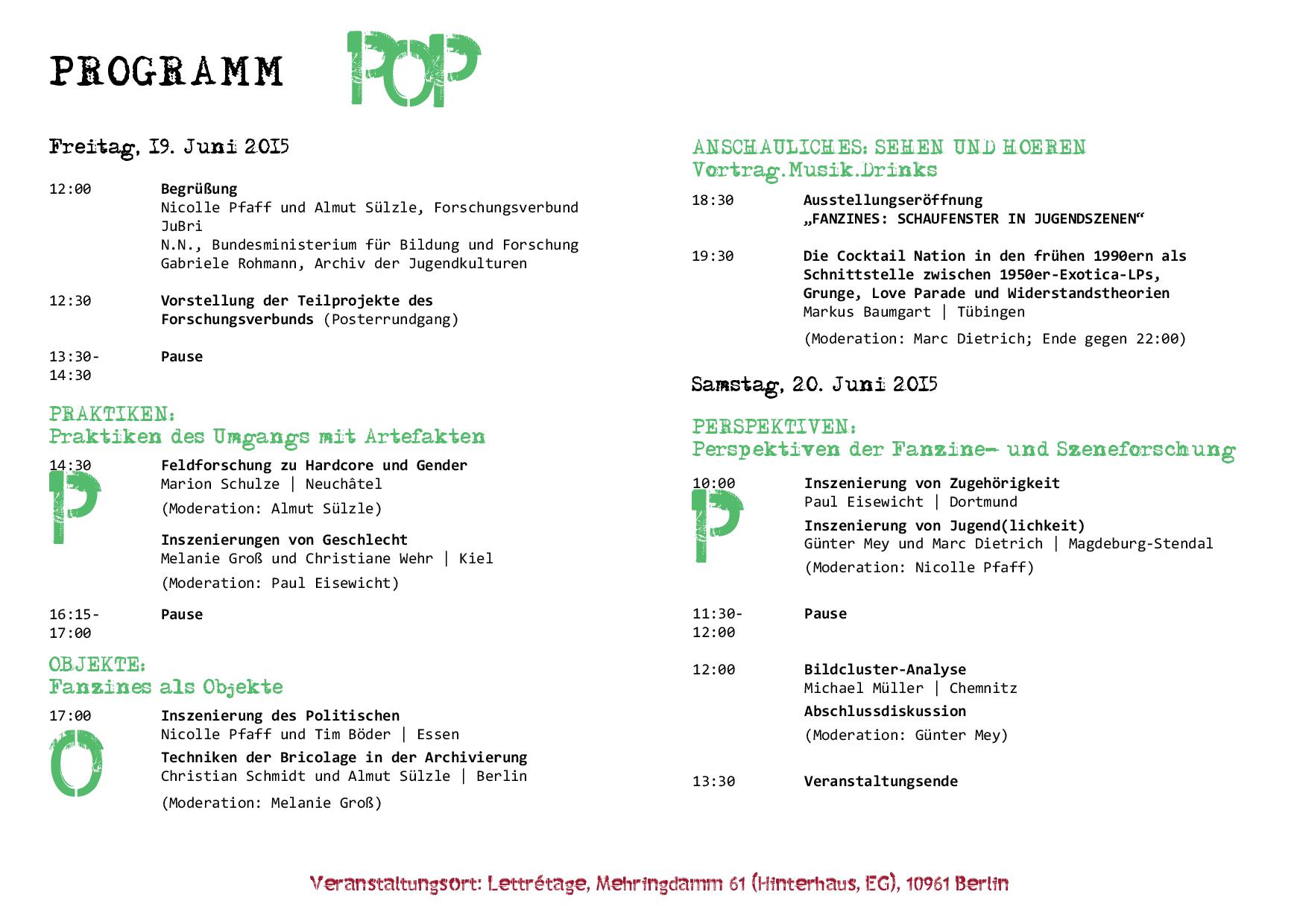
Im Zentrum der Tagung stehen jugendkulturelle Wissensbestände, Wert- und Normorientierungen – kurz: Sinnkonstruktionen – wie sie sich in Artefakten aus jugendkulturellen Szenen, insbesondere in Fanzines dokumentieren. Im Rahmen von Fachvorträgen, einer Ausstellungseröffnung und einem Rahmenprogramm werden nicht nur die archivarische und wissenschaftliche Aufarbeitung des Fanzine-Bestandes des Archivs der Jugendkulturen e.V. vorgestellt, sondern auch erste Ergebnisse aus den Teilprojekten des vom Bundesministerium für Bildung und Forschung unterstützten Forschungsverbunds "Techniken jugendlicher Bricolage – Interdisziplinäre Perspektiven auf jugendkulturelle Praktiken des Umgangs mit alltagskulturellen Objekten"(JuBri) präsentiert.
Am Beispiel der Hardcore-Szene werden in einer ersten Session Praktiken des Umgangs mit Artefakten rekonstruiert – vor allem im Hinblick auf Inszenierungen von Geschlecht. In der zweiten Session geht es um Fanzines als Objekte. Im Vergleich zu anderen Printmedien wird nach Inszenierungen des Politischen und nach Herausforderungen der Fanzine-Archivierung gefragt. Schließlich entwickelt eine dritte Session Perspektiven der Fanzine- und Szeneforschung. Dabei geht es um Analysen zur Inszenierung von Zugehörigkeit und Jugendlichkeit sowie um Zugänge zu digitalen Formaten der (jugendkulturellen) Kommunikation und Präsentation. Im Rahmen der Tagung wird die Ausstellung "Fanzines: Schaufenster in Jugendszenen" gezeigt. Anschließend können die Teilnehmenden Plattencoveranalysen mit Musik und Cocktails von DJ Markus Baumgart genießen.
Anmeldung bis zum 13. Juni unter jubri@jugendkulturen.de. Der Veranstaltungsbeitrag beträgt 25 Euro. An der Ausstellungseröffnung und dem anschließenden Abendvortrag am Freitag, 19. Juni (Beginn: 18:30 Uhr) kann auch ohne Anmeldung kostenlos teilgenommen werden.
Samstag, 31. Januar 2015
Fandom und Crowdfunding
Die aktuelle Ausgabe der Zeitschrift "New Media & Society", laut Eigenbeschreibung "a top-ranked, peer-reviewed, international journal that publishes key research from communication, media and cultural studies, as well as sociology, geography, anthropology, economics, the political and information sciences and the humanities", ist dem Thema Crowdfunding gewidmet, drei Artikel befassen sich mit Thema Fandom und Crowdfunding:
Montag, 12. Januar 2015
Citizen archivists
Sehr interessanter artikel von Jesse Jarnow, der auch Bezug zum (Musik-)Fandom hat: "Why Collecting Matters: Citizen Archivists and the Battle for Future Pasts" (Wondering Sound, 2. Jänner 2015): "While physical media is slowly becoming a thing of the past, there still remains plenty to collect. There's a vast musical world that falls beyond Spotify’s officially licensed purview, and even outside the realm of established retailers like Amazon and iTunes".
Freitag, 19. Dezember 2014
Utopisch, universal, unendlich
Die neue Ausgabe der "Büchereiperspektiven", einer österreichischen Zeitschrift für öffentliche Bibliotheken, widmet sich dem Thema "Die imaginierte Bibliothek. Bücherwelten in Literatur und Film". Darin ist mein Beitrag "Utopisch, universal, unendlich" über Bibliotheken in der Science Fiction erschienen :-) Nachzulesen auf www.bvoe.at/epaper/4_14/!
Mittwoch, 15. Januar 2014
Motivationswunder
Was mich am Star-Trek Universum am meisten fasziniert ist, dass da alle ernsthaft die ganze Zeit voll Bock auf ihren Job haben.
— hadron (@hadronized) January 13, 2014Dienstag, 1. Oktober 2013
Erster Kontakt
97% of NASA is shut down. I think it would sum up humanity nicely if our first response to alien contact was an out-of-office reply.
— Dave Turner (@mrdaveturner) October 1, 2013
Dienstag, 23. Juli 2013
CFP: Imagining Science Fiction Dangerously
Source: Mail sent by Sean Redmond to the Fan Studies list.
The power of science fiction lies in its dangers. Science fiction imagines other worlds that can challenge, unsettle, and disturb the known world. It turns on dangerous ideas, affective ruptures, political critique, and unfamiliar textures. It has the power to threaten the established order of things and open gaps in the way we conceptualise the contemporary world. But are we losing sight of the dangers of science fiction as we try to come to understand it? Istvan Csicsery-Ronay warned "there is a danger in making Science Fiction into an academic specialty. [...] I'm somewhat suspicious of treating Science Fiction as if it were a circumscribed subject with a canon and set of reading protocols" (interview with Rain Taxi, 2009).
This special issue aims to address questions of:
* How can science fiction continue to be imagined dangerously in all its forms – from literature to film to gaming to art – in the face of it becoming a "discipline"?
* How does science fiction recover its danger, away from the neo-liberal safety of commercialisation and criticism that renders it as a digestible genre?
* How can academia approach science fiction in a way that both contributes to, and avoids eroding, the power and danger of science fiction?
* How can the tropes of science fiction be challenged to imagine new intersections of science and fiction?
* What do advances in science and technology mean for the dangerous dimension of science fiction?
* How is science fiction used dangerously; for example in military planning or by environmentalists imagining dangerous futures?
* How can the spaces and the textures of science fiction continue to be imagined as dangerous?
* How do practices of reading contribute to science fiction becoming "safe" (in other words, are we missing the point?), and how can practices of reading make sci-fi dangerous again?
* Where is science fiction the most unsettling, confronting, and urgent?
We invite contributions that address any of these questions from the disciplines of literature, film, gaming, art, and science and technology, and any other field with an investment in the possibilities of imagining science fiction dangerously.
The issue will be edited by the Emerging Research Group in Science Fiction at Deakin University, Australia (lead by Associate Professor Sean Redmond, Associate Professor Leon Marvell, Dr Elizabeth Braithwaite, Dr Chris Moore, and Trent Griffiths, postdoctoral student), aiming for publication in late 2014.
We welcome abstracts for of 300-350 words, along with a short biography, emailed to sean.redmond@deakin.edu.au or leon.marvell@deakin.edu.au by Friday September 20th 2013. General enquiries about the special issue or the research group are also welcome.
Notification of acceptance of articles will be by Friday October 18th 2013. Completed articles should be original work which has neither been simultaneously submitted for publication elsewhere nor published previously, and will be due in April 2014.
Samstag, 11. Mai 2013
Looking forward to Khan / Spock slash fiction
Ok so star trek has benerdict cumberbatch in it-_-I think I just had a nerdgasm.
— Nina ☯ (@NinaHanvey) May 9, 2013
Dienstag, 23. April 2013
CfP: Journal of Cult Media
Hinweis aus der Fanstudies-Mailingliste:
<snip>The Journal of Cult Media has relaunched and is currently accepting submissions for issue six. Intensities is an online journal first launched at Cardiff University in 2001 under the editorship of Matt Hills and Sara Gwenllian Jones. It later moved to Brunel University, where it was edited by David Lavery, and is currently edited (still at Brunel) by Leon Hunt.
Intensities will publish two issues a year. The journal addresses all aspects of cult media including cult television, cult film, cult radio, cult comics, literary cults and cult authors, new media cults, cult figures and celebrities, cult icons, musical cults, cult geographies, historical studies of media cults and their fandoms, cult genres (e.g. science fiction, horror, fantasy, pulp fiction, Manga, anime, Hong Kong film etc.), non-generic modes of cultishness, theorisations of cult media, relevant audience and readership studies, and work that addresses the cult media industry.
Issue six seeks submissions examining TV shows that have acquired cult status at a historical distance – both established cult shows ("The Avengers, The Prisoner, "the 'classic' series of "Doctor Who") and those that have received less (or possibly even no) critical attention. In addition, the papers will locate those shows historically, either by drawing on archive materials or suggesting new cultural, historical or institutional contexts in which they might be understood.
Submissions should be sent to intensities@brunel.ac.uk. They should be between 6000 and 8000 words, referenced Harvard style and sent as a word document – a 200 word abstract should be sent as a separate document. - Deadline for submissions is May 31st 2013.<snap>
Donnerstag, 14. März 2013
"Extremfans" bei Domian
"In der kommenden Woche lautet unser Thema: Extrem-Fans. Wir wollen mit Menschen sprechen, die Fans von Stars aus Musik, Sport, Film oder Show-Geschäft sind. Oder wir sprechen gern mit Fans von Autos, Fußballvereinen oder auch bestimmten Marken". Jetzt auf WDR.
Abonnieren
Posts (Atom)