Über meinen Google Alert bin ich auf den ausführlichen Artikel "Small Council: Is George R.R. Martin justified in being against fanfiction? (Achtung, sehr werbelastige Seite) gestößen, über den ich wiederum auf den George R. R. Martins Text "Someone Is Angry On the Internet" vom 7. Mai 2010 gekommen bin. Martin beschreibt darin eine interessante Beobachtung, was die Bedeutung des Begriffs "fan fiction" betrifft:
//zitat// One of the things I mislike about fan fiction is its NAME. Truth is, I wrote fan fiction myself. That was how I began, when I was a kid in high school writing for the dittoed comic fanzines of the early 1960s. In those days, however, the term did not mean "fiction set in someone else's universe using someone else's characters." It simply meant "stories written by fans for fans, amateur fiction published in fanzines." (...) How and when the term began to be used for what is called fan fiction today, I don't know. I wish there was another term for that, though I confess I cannot think of one that isn't either cumbersome, vague, or prejorative. But it does bother me that people hear I wrote fan fiction, and take that to mean I wrote stories about characters taken from the work of other writers without their consent". //zitatende//
Sonntag, 13. Dezember 2015

Dienstag, 8. Dezember 2015
Dezember: Science Fiction im Radiokolleg
Von 28. bis 31. Dezember 2015 ist das "Radiokolleg" (9:05 Uhr, Ö1) dem Thema "Science Fiction in Österreich" gewidmet. In der von Ulrike Schmitzer gestalteten Sendereihe gibt es folgende Schwerpunkte:
- 28.12. Franz Rottensteiner über seine Literaturzeitschrift QUARBER MERKUR und seine Herausgeberschaft im Insel- und im Suhrkamp-Verlag.
- 29.12. Helmuth W. Mommers, Hermann Urbanek, Hans Langsteiner und Alexander Dolezal über Science Fiction, Gründerzeit und die VILLA FANTASTICA.
- 30.12. Frauen und ihre Bedeutung in der Science Fiction, am Beispiel von Alice B. Sheldon alias James Tiptree jr. im Septime Verlag, Wien.
- 31.12. Franz Rottensteiner über die polnische SF-Ikone Stanislaw Lem und dessen Zeit in Wien.
Mittwoch, 1. April 2015
Fanzines: Schaufenster in Jugendszenen
Am 19./20. Juni 2015 findet in der Lettrétage, Mehringdamm 61, 10961 Berlin, eine Tagung zum Thema "Fanzines: Schaufenster in Jugendszenen. Praktiken. Objekte. Perspektiven" statt (Programm als jpg).
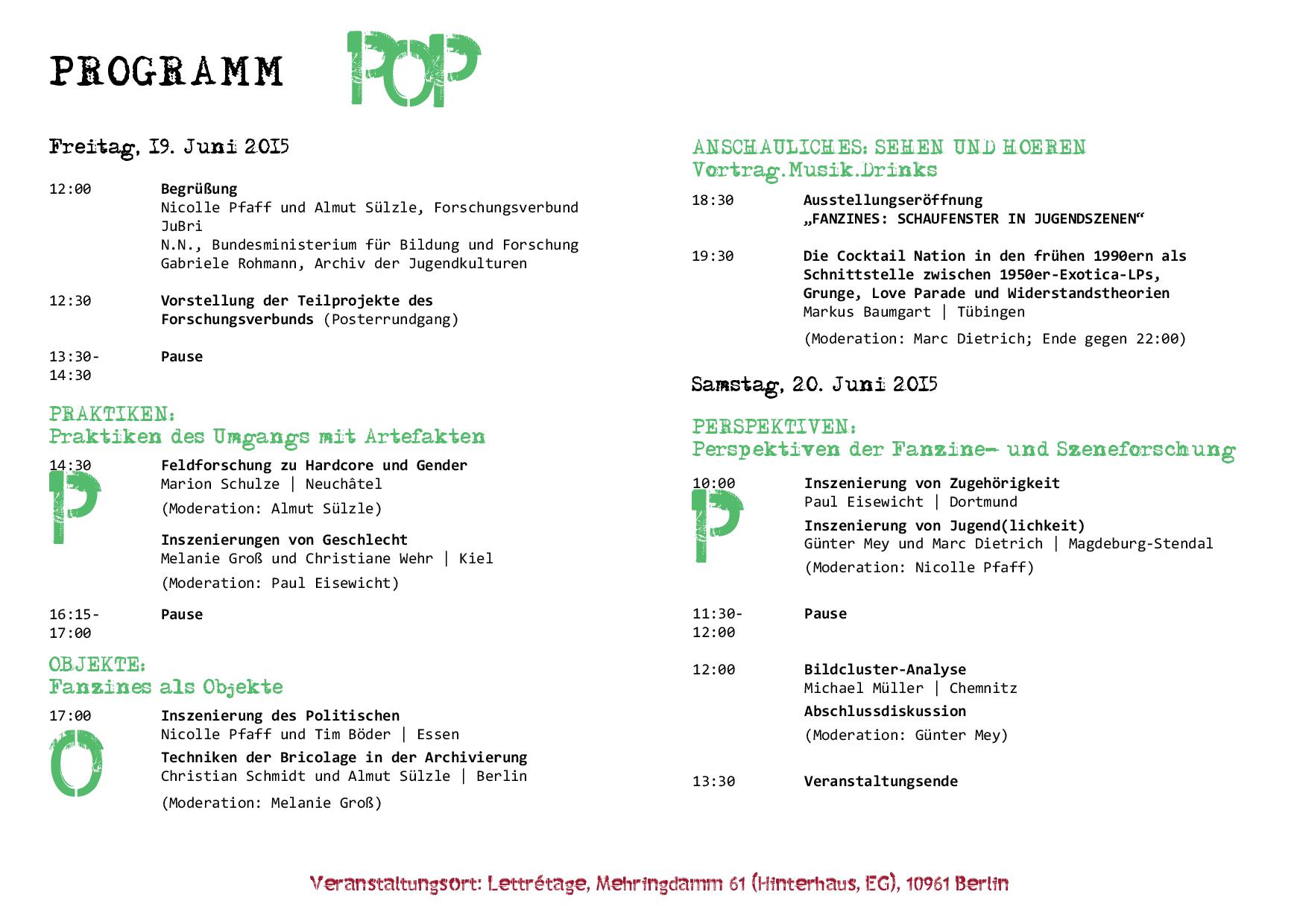
Im Zentrum der Tagung stehen jugendkulturelle Wissensbestände, Wert- und Normorientierungen – kurz: Sinnkonstruktionen – wie sie sich in Artefakten aus jugendkulturellen Szenen, insbesondere in Fanzines dokumentieren. Im Rahmen von Fachvorträgen, einer Ausstellungseröffnung und einem Rahmenprogramm werden nicht nur die archivarische und wissenschaftliche Aufarbeitung des Fanzine-Bestandes des Archivs der Jugendkulturen e.V. vorgestellt, sondern auch erste Ergebnisse aus den Teilprojekten des vom Bundesministerium für Bildung und Forschung unterstützten Forschungsverbunds "Techniken jugendlicher Bricolage – Interdisziplinäre Perspektiven auf jugendkulturelle Praktiken des Umgangs mit alltagskulturellen Objekten"(JuBri) präsentiert.
Am Beispiel der Hardcore-Szene werden in einer ersten Session Praktiken des Umgangs mit Artefakten rekonstruiert – vor allem im Hinblick auf Inszenierungen von Geschlecht. In der zweiten Session geht es um Fanzines als Objekte. Im Vergleich zu anderen Printmedien wird nach Inszenierungen des Politischen und nach Herausforderungen der Fanzine-Archivierung gefragt. Schließlich entwickelt eine dritte Session Perspektiven der Fanzine- und Szeneforschung. Dabei geht es um Analysen zur Inszenierung von Zugehörigkeit und Jugendlichkeit sowie um Zugänge zu digitalen Formaten der (jugendkulturellen) Kommunikation und Präsentation. Im Rahmen der Tagung wird die Ausstellung "Fanzines: Schaufenster in Jugendszenen" gezeigt. Anschließend können die Teilnehmenden Plattencoveranalysen mit Musik und Cocktails von DJ Markus Baumgart genießen.
Anmeldung bis zum 13. Juni unter jubri@jugendkulturen.de. Der Veranstaltungsbeitrag beträgt 25 Euro. An der Ausstellungseröffnung und dem anschließenden Abendvortrag am Freitag, 19. Juni (Beginn: 18:30 Uhr) kann auch ohne Anmeldung kostenlos teilgenommen werden.
Samstag, 31. Januar 2015
Fandom und Crowdfunding
Die aktuelle Ausgabe der Zeitschrift "New Media & Society", laut Eigenbeschreibung "a top-ranked, peer-reviewed, international journal that publishes key research from communication, media and cultural studies, as well as sociology, geography, anthropology, economics, the political and information sciences and the humanities", ist dem Thema Crowdfunding gewidmet, drei Artikel befassen sich mit Thema Fandom und Crowdfunding:
Montag, 12. Januar 2015
Citizen archivists
Sehr interessanter artikel von Jesse Jarnow, der auch Bezug zum (Musik-)Fandom hat: "Why Collecting Matters: Citizen Archivists and the Battle for Future Pasts" (Wondering Sound, 2. Jänner 2015): "While physical media is slowly becoming a thing of the past, there still remains plenty to collect. There's a vast musical world that falls beyond Spotify’s officially licensed purview, and even outside the realm of established retailers like Amazon and iTunes".
Freitag, 19. Dezember 2014
Utopisch, universal, unendlich
Die neue Ausgabe der "Büchereiperspektiven", einer österreichischen Zeitschrift für öffentliche Bibliotheken, widmet sich dem Thema "Die imaginierte Bibliothek. Bücherwelten in Literatur und Film". Darin ist mein Beitrag "Utopisch, universal, unendlich" über Bibliotheken in der Science Fiction erschienen :-) Nachzulesen auf www.bvoe.at/epaper/4_14/!
Mittwoch, 15. Januar 2014
Motivationswunder
Was mich am Star-Trek Universum am meisten fasziniert ist, dass da alle ernsthaft die ganze Zeit voll Bock auf ihren Job haben.
— hadron (@hadronized) January 13, 2014Dienstag, 1. Oktober 2013
Erster Kontakt
97% of NASA is shut down. I think it would sum up humanity nicely if our first response to alien contact was an out-of-office reply.
— Dave Turner (@mrdaveturner) October 1, 2013
Dienstag, 23. Juli 2013
CFP: Imagining Science Fiction Dangerously
Source: Mail sent by Sean Redmond to the Fan Studies list.
The power of science fiction lies in its dangers. Science fiction imagines other worlds that can challenge, unsettle, and disturb the known world. It turns on dangerous ideas, affective ruptures, political critique, and unfamiliar textures. It has the power to threaten the established order of things and open gaps in the way we conceptualise the contemporary world. But are we losing sight of the dangers of science fiction as we try to come to understand it? Istvan Csicsery-Ronay warned "there is a danger in making Science Fiction into an academic specialty. [...] I'm somewhat suspicious of treating Science Fiction as if it were a circumscribed subject with a canon and set of reading protocols" (interview with Rain Taxi, 2009).
This special issue aims to address questions of:
* How can science fiction continue to be imagined dangerously in all its forms – from literature to film to gaming to art – in the face of it becoming a "discipline"?
* How does science fiction recover its danger, away from the neo-liberal safety of commercialisation and criticism that renders it as a digestible genre?
* How can academia approach science fiction in a way that both contributes to, and avoids eroding, the power and danger of science fiction?
* How can the tropes of science fiction be challenged to imagine new intersections of science and fiction?
* What do advances in science and technology mean for the dangerous dimension of science fiction?
* How is science fiction used dangerously; for example in military planning or by environmentalists imagining dangerous futures?
* How can the spaces and the textures of science fiction continue to be imagined as dangerous?
* How do practices of reading contribute to science fiction becoming "safe" (in other words, are we missing the point?), and how can practices of reading make sci-fi dangerous again?
* Where is science fiction the most unsettling, confronting, and urgent?
We invite contributions that address any of these questions from the disciplines of literature, film, gaming, art, and science and technology, and any other field with an investment in the possibilities of imagining science fiction dangerously.
The issue will be edited by the Emerging Research Group in Science Fiction at Deakin University, Australia (lead by Associate Professor Sean Redmond, Associate Professor Leon Marvell, Dr Elizabeth Braithwaite, Dr Chris Moore, and Trent Griffiths, postdoctoral student), aiming for publication in late 2014.
We welcome abstracts for of 300-350 words, along with a short biography, emailed to sean.redmond@deakin.edu.au or leon.marvell@deakin.edu.au by Friday September 20th 2013. General enquiries about the special issue or the research group are also welcome.
Notification of acceptance of articles will be by Friday October 18th 2013. Completed articles should be original work which has neither been simultaneously submitted for publication elsewhere nor published previously, and will be due in April 2014.
Samstag, 11. Mai 2013
Looking forward to Khan / Spock slash fiction
Ok so star trek has benerdict cumberbatch in it-_-I think I just had a nerdgasm.
— Nina ☯ (@NinaHanvey) May 9, 2013
Dienstag, 23. April 2013
CfP: Journal of Cult Media
Hinweis aus der Fanstudies-Mailingliste:
<snip>The Journal of Cult Media has relaunched and is currently accepting submissions for issue six. Intensities is an online journal first launched at Cardiff University in 2001 under the editorship of Matt Hills and Sara Gwenllian Jones. It later moved to Brunel University, where it was edited by David Lavery, and is currently edited (still at Brunel) by Leon Hunt.
Intensities will publish two issues a year. The journal addresses all aspects of cult media including cult television, cult film, cult radio, cult comics, literary cults and cult authors, new media cults, cult figures and celebrities, cult icons, musical cults, cult geographies, historical studies of media cults and their fandoms, cult genres (e.g. science fiction, horror, fantasy, pulp fiction, Manga, anime, Hong Kong film etc.), non-generic modes of cultishness, theorisations of cult media, relevant audience and readership studies, and work that addresses the cult media industry.
Issue six seeks submissions examining TV shows that have acquired cult status at a historical distance – both established cult shows ("The Avengers, The Prisoner, "the 'classic' series of "Doctor Who") and those that have received less (or possibly even no) critical attention. In addition, the papers will locate those shows historically, either by drawing on archive materials or suggesting new cultural, historical or institutional contexts in which they might be understood.
Submissions should be sent to intensities@brunel.ac.uk. They should be between 6000 and 8000 words, referenced Harvard style and sent as a word document – a 200 word abstract should be sent as a separate document. - Deadline for submissions is May 31st 2013.<snap>
Donnerstag, 14. März 2013
"Extremfans" bei Domian
"In der kommenden Woche lautet unser Thema: Extrem-Fans. Wir wollen mit Menschen sprechen, die Fans von Stars aus Musik, Sport, Film oder Show-Geschäft sind. Oder wir sprechen gern mit Fans von Autos, Fußballvereinen oder auch bestimmten Marken". Jetzt auf WDR.
Freitag, 1. März 2013
Vergil-Fan Fiction ;-)
Dante Alighieri, diary: "Ich have nat finisshed my two prose treatises. Too busye workinge on Vergile/Hell fanfic. Ich am such a slacker."
— Chaucer Doth Tweet (@LeVostreGC) March 1, 2013
Sonntag, 3. Februar 2013
Adapting Shakespeare for Star Trek
Ich habe gerade den interessanten Beitrag von Karolina Kazimierczak über die Übersetzung zweier Shakespeare-Dramen ins Klingonische entdeckt: "Adapting Shakespeare for Star Trek and Star Trek for Shakespeare: The Klingon Hamlet and the Spaces of Translation". In: Studies in Popular Culture, 32 (2010) 2, S. 35 - 55 (pdf).
Sonntag, 27. Januar 2013
ST-Phile 1: "The original Star Trek idea"
Laura J. Sweeney bietet auf ihrer Website zu ihrer Master Thesis "The Origins of the Star Trek Phenomenon: Gene Roddenberry, the Original Series, and Science Fiction Fandom in the 1960s" einiges Material, darunter zum Beispiel Auszüge aus frühen Fanzines. Aufgefallen ist mir der Beitrag über "The original Star Trek idea as submitted to NBC by Gene Roddenberry" (noch mit Captain Robert April), der in der ersten Ausgabe von ST-Phile erschienen ist. Sweeney führte anscheinend Interviews mit den Fans der ersten Stunde Juanita Coulson, Bjo Trimble und Devra Langsam. Die Thesis ist auch als Buch erschienen, vielleicht sollte ich die dreizehn Euro ausgeben...
Montag, 21. Januar 2013
Ohnmächtige Cumberbatch-Fans
Rob Bricken berichtet in io9 über eine Aussage von Benedict Cumberbatch zu seiner Rolle in Star Trek XII (bzw. genauer gesagt Star Trek AOS II): "The costumes look great. Some of them were very cumbersome and heavy, but some were very snug. You can almost see what religion I am" und kommentiert: "That sound you just heard was 100,000 erotic Benedict Cumberbatch fan fic writers fainting in pure joy".
Donnerstag, 17. Januar 2013
Pornographic #startrek comic strips
James Doohan schreibt in seiner Autobiographie "Beam me up, Scotty" aus dem Jahr 1996: "And there are the truly odd aspects of fandom. For example, so I've been told: pornographic comic strips of all of us, even one between Kirk and Spock – I’m always with some girl" (S. 182) - da hat er wohl nicht geahnt, was noch alles folgt :-)
Dienstag, 15. Januar 2013
Interview mit Betreiberin von TrekNation
Heute habe ich ein zweistündiges Interview mit Nadia Volkrodt, der Betreiberin von TrekNation, einer Plattform für Star Trek-Fan Fiction, geführt.
Freitag, 11. Januar 2013
Abonnieren
Posts (Atom)